Your Wedding Invitation Should Feel Like You, and Made for Them
By the Ayozan team · · 6 min read
Two questions every invitation answers
A wedding invitation quietly answers two questions before anyone reads the date. The first is who are these two people? The second is did they think of me?
Most invitations fail both. They are a template with two names swapped in, forwarded to two hundred people as the same PDF. The guest opens it in the same WhatsApp thread as a grocery list, sees a card that could belong to any couple, and scrolls on.
Your invitation is the first thing your guests receive from the two of you as a couple. It should feel like you. And it should feel like it was made for them. Those are two different jobs, and the rest of this post is about doing both.
Feel like you
An invitation feels like you when someone who knows you could guess it was yours with the names covered. That comes from three things: where you are from, what you believe, and how you actually talk.
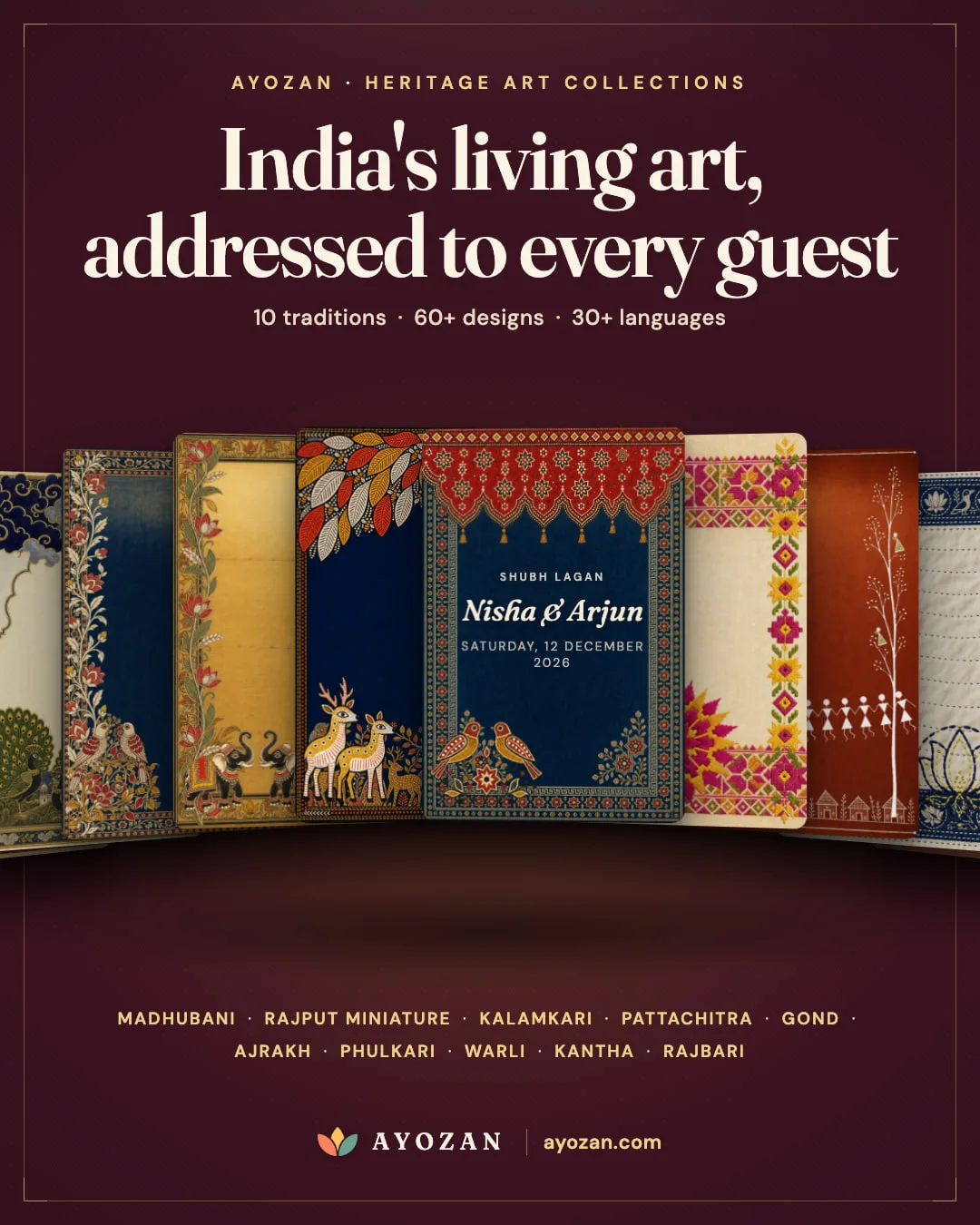
Where you are from. A Bengali wedding does not look like a Marwari one, and a Kerala wedding does not look like either. The motifs, the colours, the shape of the envelope, even the way the card is folded carry a region. Ayozan’s catalogue is organised by faith, region and community, so you start from a design that already speaks your family’s visual language instead of a generic floral border with a mandap pasted on. There are Mithila, Kalamkari, Gond, Pattachitra and Rajasthani royal families alongside Hindu, Sikh, Christian and Muslim ceremonies, each drawn from the real art of that place.
What you believe. The invocation at the top of the card matters to your parents even if you would not have thought of it. Ganesh, Om, Bismillah, a cross, Ik Onkar: the right one should be there by default for the ceremony you chose, not something you have to remember to add.
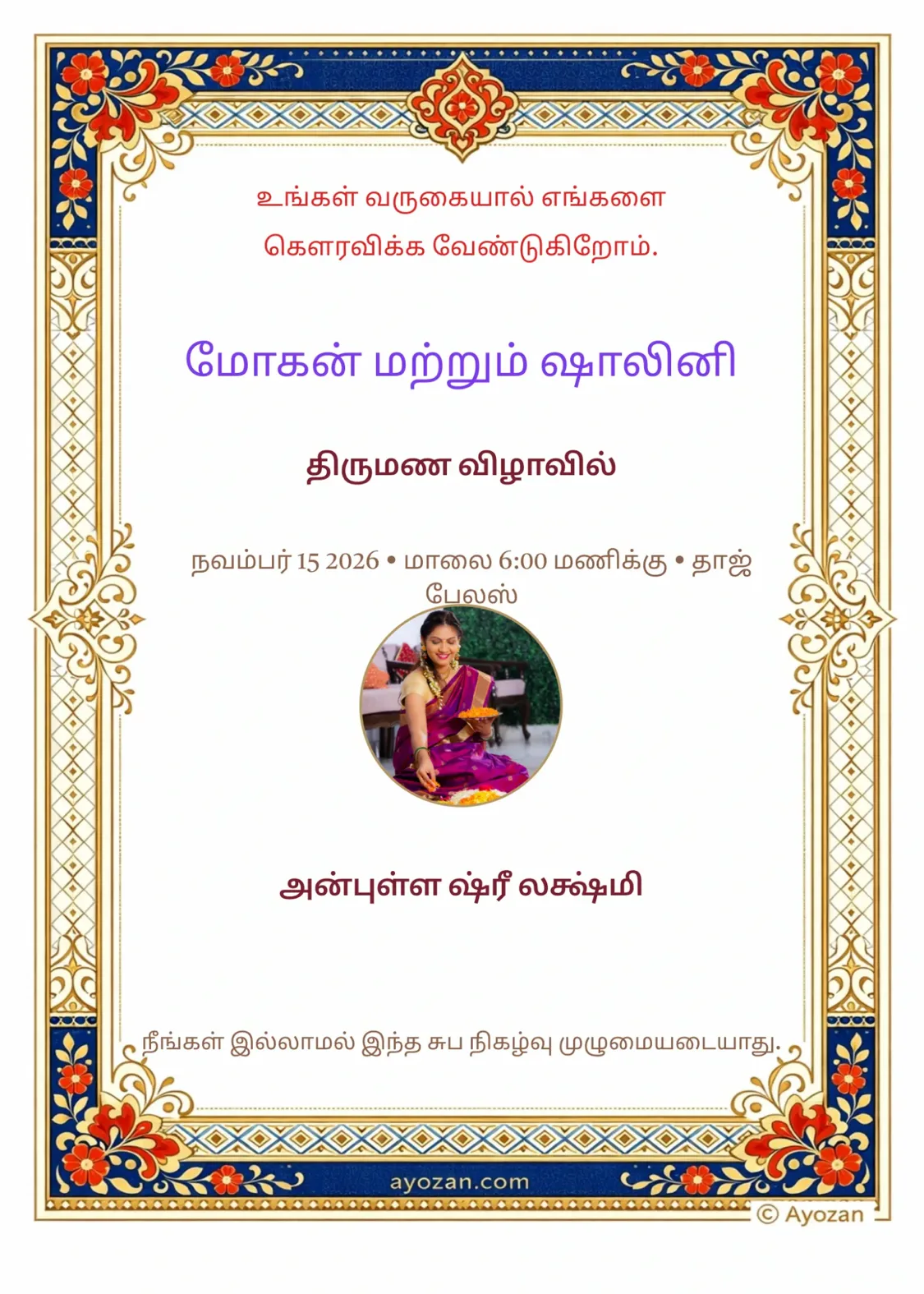
How you talk. Your grandmother reads Hindi. Your college friends read English. Your in-laws read Tamil. An invitation that feels like you is in the languages your people actually speak, and Ayozan translates your card into more than thirty Indian languages so you can send each guest the one they will read without effort.
The test is simple. Put your invitation next to five others from this season. If a friend cannot pick yours out, it does not feel like you yet.
Made for them
Think about the last paper invitation that meant something to you. Almost certainly it had your name written on the envelope by hand. That one gesture told you the couple had sat down, thought of you specifically, and taken thirty seconds to say so.
The digital version of that gesture has mostly been lost. One PDF, one broadcast list, two hundred identical copies. Nobody feels chosen by a forward.
Made for them means every guest gets their own invitation, not a copy of one. On Ayozan that happens in four ways:
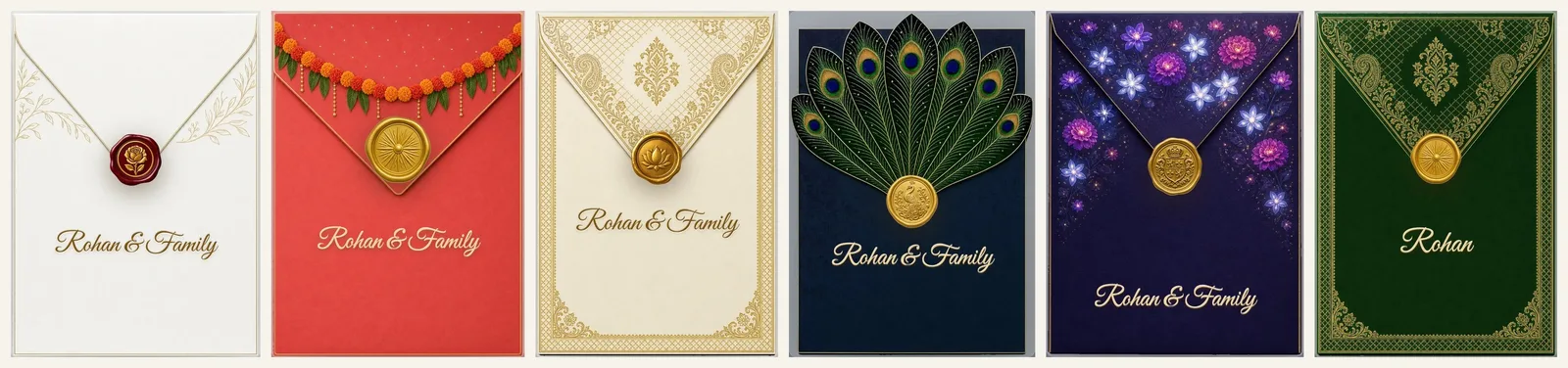
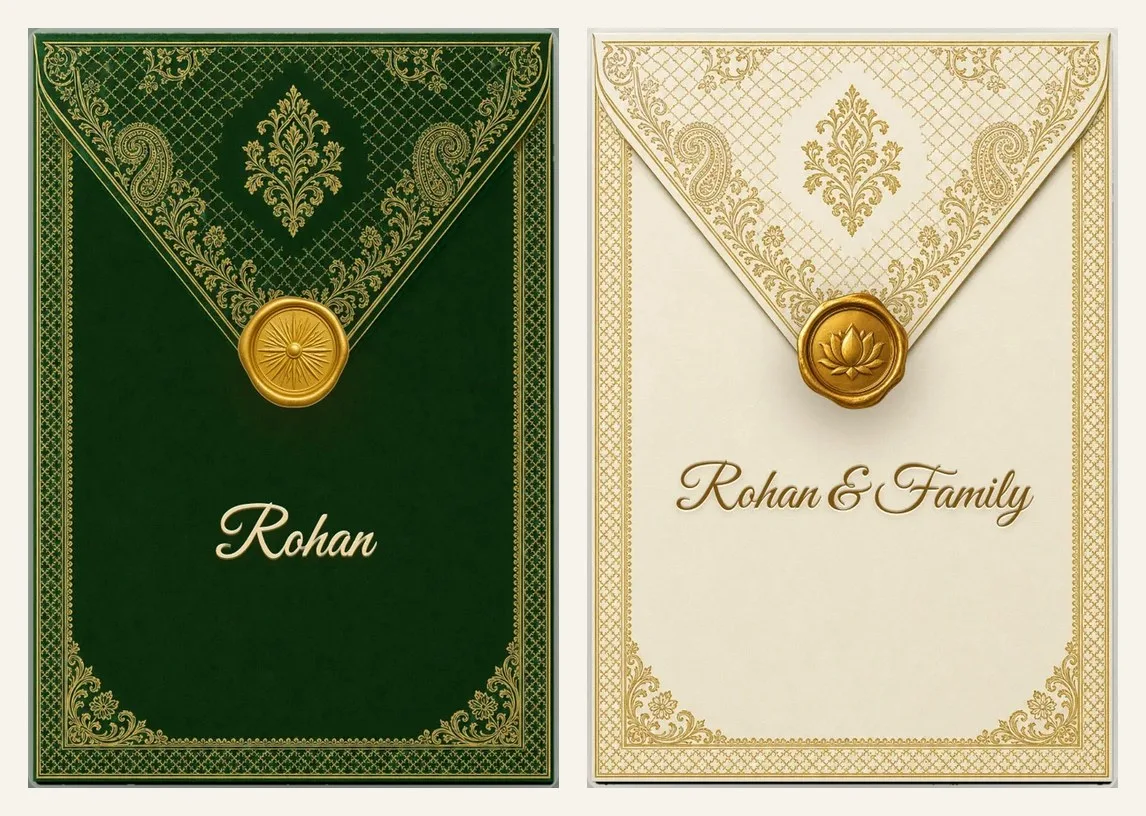
- Their name on the envelope. Each guest’s link opens a sealed envelope with their name on it, and the name writes itself across the front as they watch. Your masi sees Sunita Masi. Your boss sees Mr. Rajan Iyer. Your friend sees Priya.
- Their salutation. The line inside the card changes with the relationship. Elders get the respectful form. Friends get the warm one. Families invited together are addressed together.
- Their language. The same card goes out in Hindi to one guest and in Kannada to the next, from one design, with nothing for you to redo.
- A note that is only for them. A personal message, a photo of the two of you with that guest, or a short voice note that plays when they open it. Not on everyone’s card. Just on theirs.
None of this is more work for you. You add a guest once, with a name and a phone number, and the invitation is assembled for that person. The effort is on the software’s side. The feeling of being chosen is on the guest’s side.
The arrival is the memory
Guests do not remember the font on your card. They remember the moment it arrived.
With paper, that moment was the doorbell, the envelope, the wax seal, the fold. A digital invitation can keep every one of those beats if it is built as an experience rather than an image. On Ayozan the guest taps a link and sees a sealed envelope with their name on it. They press the seal. The flap lifts, the card rises out, and the invitation plays, as a short film or as a card they can flip through at their own pace.
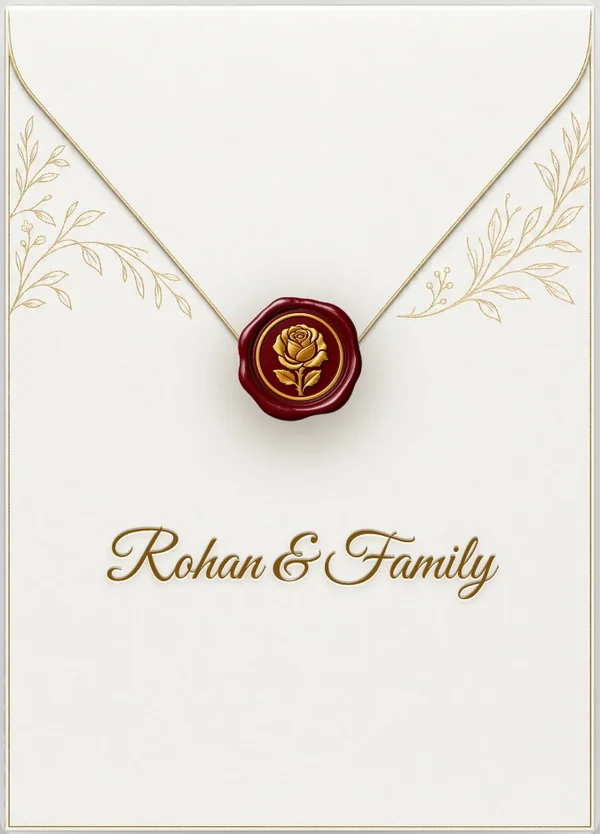
You also choose how it arrives. A dakiya on a bicycle. A baraat. A shikara drifting in on Dal Lake. A helicopter lowering the envelope on a cloth. A ticket or a passport with a stamp for each function. These sound like gimmicks until you watch a sixty-year-old uncle press the seal a second time to see it again.
And unlike paper, the invitation stays alive after it arrives. Change the venue or the time and every guest’s copy updates on its own. No resend, no “please ignore the earlier message”. The guest replies from the same page, and their RSVP lands with you without a form or a follow-up call.
How it works on Ayozan
The whole thing takes an evening, not a week.
- Pick a design that is yours. Filter wedding invitation designs by ceremony, faith, region and community. Choose a classic card or a Regal design with motion on the surface. Every design comes with pre-written wording for each function, so you edit a draft instead of staring at a blank card.
- Make it yours. Change the names, dates, venues and the wording. Add your photo. Swap the invocation. The card, its envelope and its seal are matched for you, and you can change any of them.
- Add your languages. Choose the languages your guests read. Ayozan translates the card and keeps the layout intact, so the Tamil edition looks as finished as the English one.
- Add your guests. A name, a phone number, a relationship, and the language they read. Do it one at a time or paste a list. Add a personal note, photo or voice message for the guests who deserve one.
- Choose the arrival. Pick the envelope, the seal, the delivery and the music. Preview exactly what each guest will see, as a card or as a video invitation.
- Send on WhatsApp. Each guest gets their own link in their own chat. Groups and families can get one shared link. RSVPs and replies come back to your dashboard as they arrive.
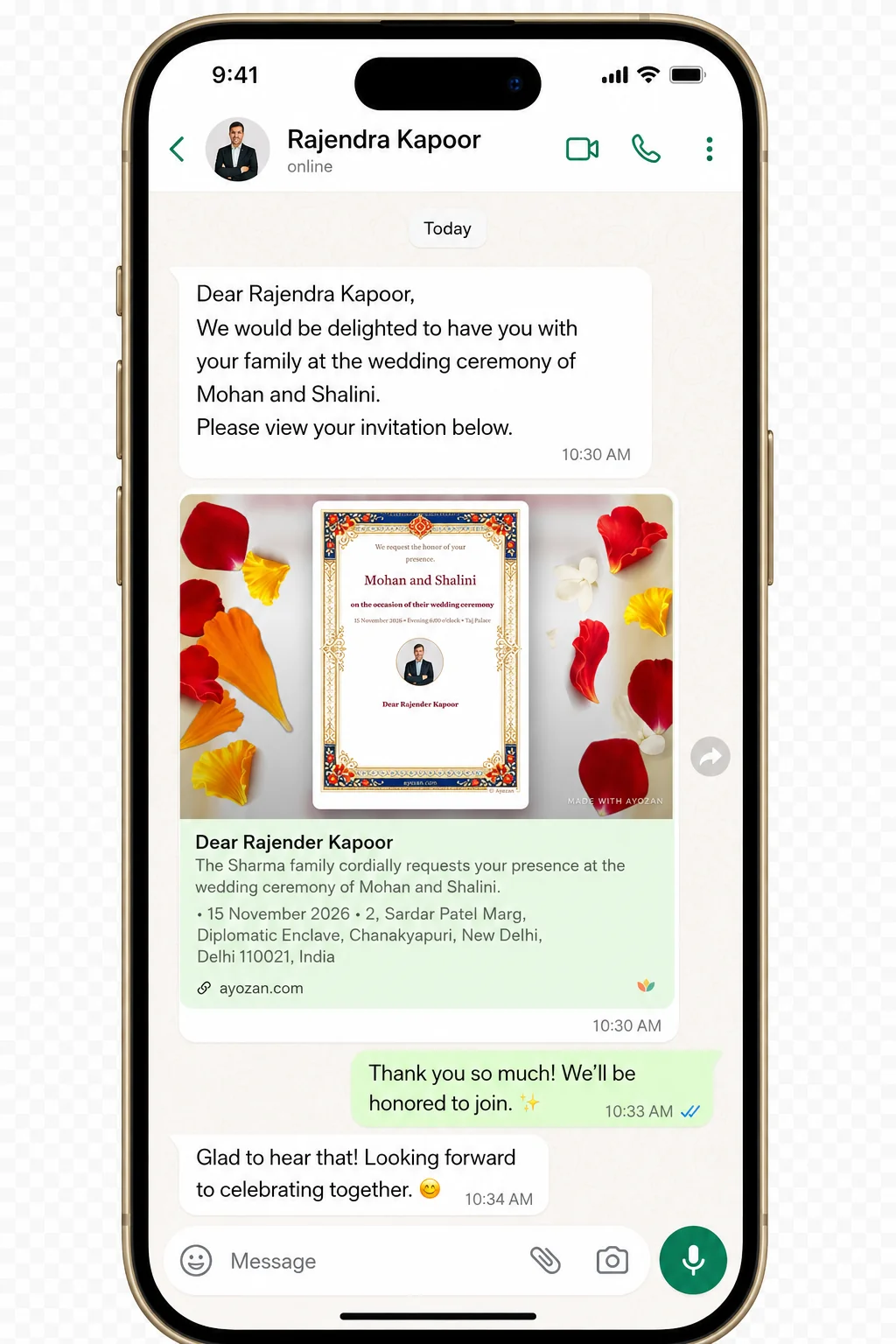
If something changes later, edit once. Every guest’s invitation updates in place.
Before you press send
Open your invitation the way a guest will, on a phone, in WhatsApp, and ask the two questions from the top of this post.
Does it feel like us? Could a friend pick it out from five others?
Does it feel made for them? Would your grandmother see her own name, in her own language, and know you thought of her?
If the answer to either is no, it is a forward, not an invitation. Fix that before the date, the venue or the dress code, because those get read only if the guest opens it feeling chosen.
Designing and previewing is free. Start in the Ayozan studio, pick the design that looks like your family, and send the first one to the person who would notice.
Create your invitation on Ayozan
Personalize one design for every guest — their name in their language and script, with WhatsApp video, PDF, and RSVP. Free to start.
Planning the whole wedding? Your invitation comes with a wedding website and RSVP tracking.